
Annie Hollister is an Honors Attorney at the U.S. Department of Labor and an alumna of Harvard Law School.
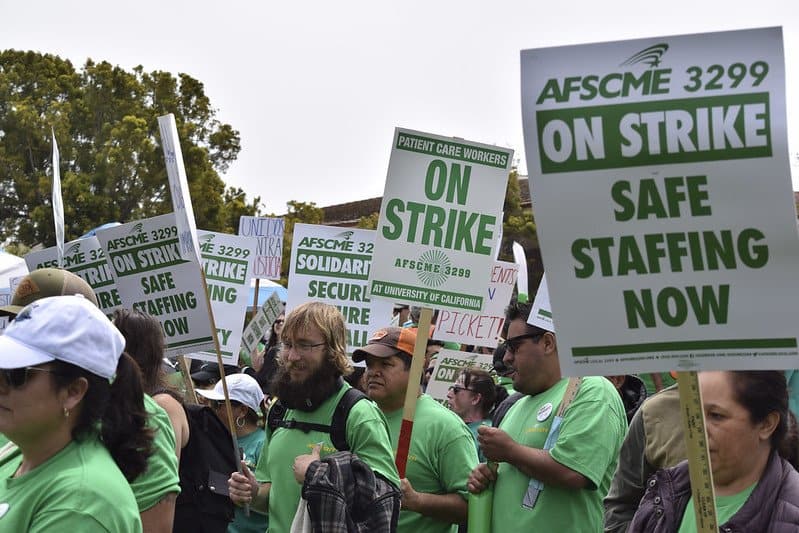
Janitors, cooks, operating room assistants, and other low-paid employees of the University of California medical system are on strike this week to protest the UC system’s reliance on outsourcing contracts. The striking workers are members of AFSCME 3299, which represents 25,000 UC employees statewide. Union representatives say that the University of California has outsourced jobs in violation of its union contract, and that this outsourcing harms patient care. The UC says that they have offered AFSCME leaders “greater input into contracting decisions” through the creation of joint management committees, but that the union has rejected the proposal.
Last week, Vail reported that staff at the Southern Poverty Law Center are organizing to unionize under the News Guild. On Tuesday, management at SPLC announced that they will not voluntarily recognize the union. In a press release, interim President Karen Baynes-Dunning wrote that the civil rights organization’s “support for unions and, more importantly, all voices being heard and the right to vote, drive us toward an election and voting process.” Baynes-Dunning took over SPLC’s leadership in April of this year, after founder Morris Dees was ousted following allegations of sexual misconduct. SPLC leadership have pledged not to engage in an anti-union campaign, but have retained Hunton Andrews Kurth, a law firm that specializes in representing organizations that “strongly desire to remain union-free.”
At least five employees have resigned from GitHub in protest over the company’s contract with Immigration and Customs Enforcement. The software developer’s CEO Nat Friedman wrote in an open letter last month that the contract was “made through one of our reseller partners,” but declined to terminate the $200,000 service agreement. GitHub is hosting its annual conference in San Francisco this week, and Vice reports that several speakers have dropped out of the event in response to the company’s refusal to cancel the contract.
Bloomberg reports that Google has fired one worker and suspended two others, allegedly in retaliation for labor-related activism. A Google representative said that employees were placed on leave for violating the company’s confidentiality policies. According to Bloomberg, employees familiar with the matter said that the suspended workers were key agitators against new community guidelines that critics say resemble censorship.
The New York Times investigates the effect of minimum wage increases on border towns in New York state. According to the Times, on-the-ground stories largely reflect Fed findings that higher wages have not increased unemployment. Small-business owners also report that, for the most part, higher labor costs have not proved destructive to their financial sustainability, although some worry that higher wages will make the region less competitive in the long run.
Finally, for Wired, Jessica Bruder profiles Amazon workers who walked off the job in December of last year. About fifty workers, most of whom are Somali American immigrants, protested outside of a Shakopee, Minnesota fulfillment center in what Wired calls the first coordinated strike against Amazon in North America. The event was organized by the Awood Center, a non-union organization dedicated to building East African worker power. Awood co-founder Nimo Omar began organizing Amazon workers while she was a college student. Her campaign began to gain traction in late 2017, when Amazon ended its direct shuttle service to and from a neighborhood where many of Shakopee’s Somali American employees live. Bruder’s detailed piece highlights some of the successes, failures, and challenges of organizing outside of the structure of a traditional labor union.




Daily News & Commentary
Start your day with our roundup of the latest labor developments. See all
March 29
The Department of Veterans Affairs re-terminates its collective bargaining agreement despite a preliminary injunction, and the Federal Labor Relations Authority announces new rules increasing the influence of political appointees over federal labor relations.
March 27
“Cesar Chavez Day” renamed “Farmworkers Day” in California after investigation finds Chavez engaged in rampant sexual abuse.
March 26
Supreme Court hears oral argument in an FAA case; NLRB rules that Cemex does not impose an enforceable deadline for requesting an election; DOL proposes raising wage standards for H-1B workers.
March 25
UPS rescinded its driver buyout program; California court dismissed a whistleblower retaliation suit against Meta; EEOC announced $15 million settlement to resolve vaccine-related religious discrimination case.
March 24
The WNBPA unanimously votes to ratify the league’s new CBA; NYU professors begin striking; and a district court judge denies the government’s motion to dismiss a case challenging the Trump administration’s mass revocation of international student visas.
March 23
MSPB finds immigration judges removal protections unconstitutional, ICE deployed to airports.